Predict What Happens Next: Prediction Markets and AI Forecasting in Global Watch
Intelligence is about the past and present. Forecasting is about what comes next. Most dashboards give you one or the other. Global Watch gives you both.
By integrating Polymarket prediction market data with AI-powered geopolitical forecasting, Global Watch lets you see not just what’s happening, but what the collective intelligence of bettors and algorithms thinks will happen.
Polymarket Integration: The Wisdom of Crowds
Prediction markets have consistently outperformed expert panels, polls, and traditional forecasting models. When real money is on the line, participants have strong incentives to be accurate rather than ideological.
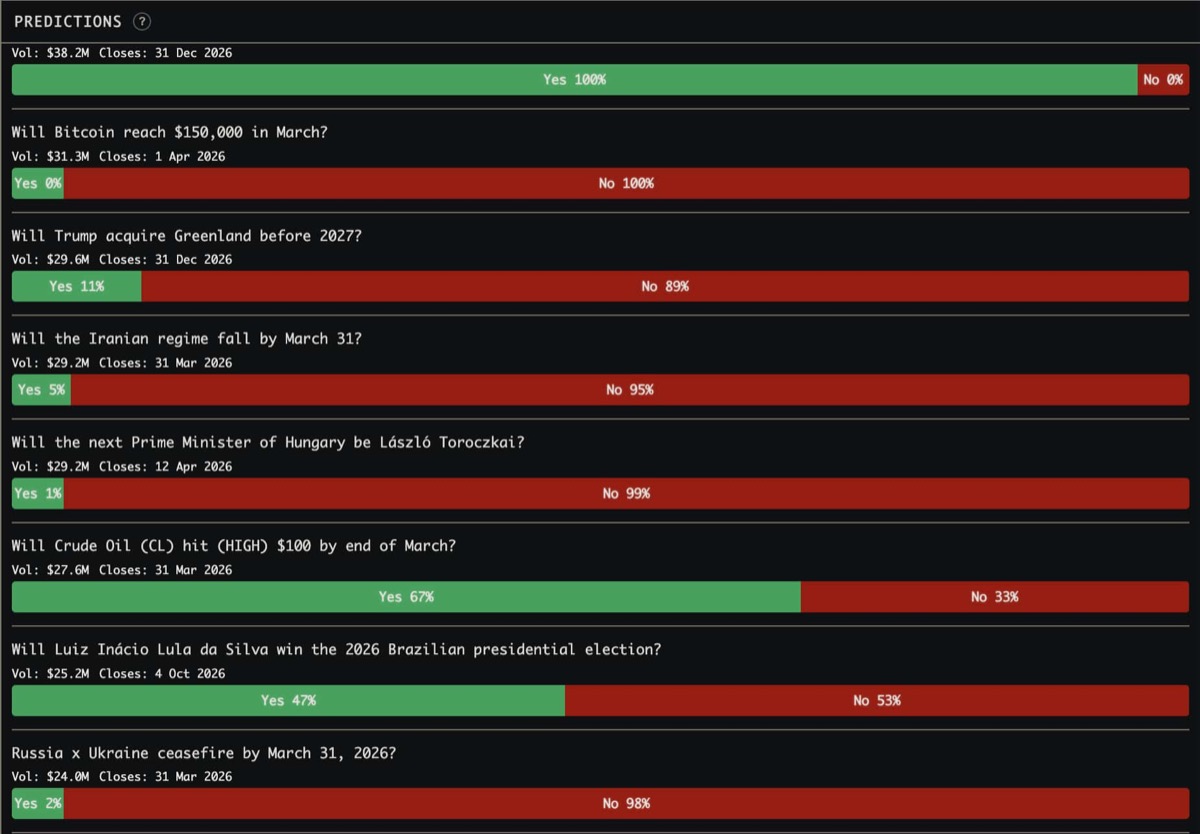
Global Watch pulls real-time data from Polymarket, the largest decentralized prediction market:
- Yes/No probability bars with percentage displays
- Trading volume ($K/$M) indicating market confidence
- Expiration dates for time-bound predictions
- Direct links to the Polymarket question for deeper analysis or trading
The predictions panel shows questions relevant to geopolitical events: elections, military escalations, trade deals, policy decisions, sanctions, and diplomatic outcomes.
What Prediction Markets Tell You (That News Doesn’t)
News tells you what happened. Analysis tells you what it means. Prediction markets tell you what’s likely to happen next, with a probability attached.
Example: Iran Nuclear Deal
- News: “Talks resume in Vienna”
- Analysis: “Prospects remain uncertain”
- Prediction Market: “Nuclear deal by December: 23% ($4.2M volume)”
That 23% is more actionable than any editorial. And the $4.2M volume tells you this isn’t idle speculation; it’s informed money.
Example: Taiwan Strait
- News: “PLA conducts exercises near Taiwan”
- Analysis: “Tensions elevated but unclear”
- Prediction Market: “China military action against Taiwan in 2025: 8% ($12M volume)”
The 8% is low, but it was 3% last month. The direction matters as much as the level.
Global Watch displays these probabilities alongside the intelligence data that drives them, so you can evaluate whether the market is ahead of or behind the signals.
AI Deduction: Machine Forecasting Grounded in Data
Global Watch’s AI Deduction panel goes beyond simple summarization. It provides interactive geopolitical timeline forecasting:
- Select a developing situation (a country, a theater, a specific event)
- The AI synthesizes current data: CII scores, news velocity, military signals, prediction market odds
- It generates potential escalation and de-escalation paths with reasoning
- Each forecast point is grounded in cited headlines and data points
- Cross-reference with prediction market data for market sentiment alignment
This isn’t the AI guessing. It’s the AI organizing the signals you’re already seeing into possible futures, with sources you can verify.
The 4-Tier LLM Chain for Forecasting
The AI Deduction feature uses Global Watch’s standard 4-tier fallback:
- Local LLM (Ollama/LM Studio): Fully private forecasting on your hardware
- Groq (Llama 3.1 8B): Fast cloud inference
- OpenRouter: Multi-model fallback
- Browser T5: Offline capability via Transformers.js
For sensitive forecasting work (government, corporate intelligence), Tier 1 means your analytical queries never leave your network.
Triangulating Signals: Markets + AI + Data
The most powerful use of Global Watch’s forecasting isn’t any single source. It’s the triangulation:
| Signal Source | What It Provides | Strength |
|---|---|---|
| Prediction markets | Crowd-aggregated probability | Calibrated, market-tested |
| AI Deduction | Structured scenario analysis | Comprehensive, sourced |
| CII scores | Quantitative instability measure | Algorithmic, consistent |
| News velocity | Information flow rate | Leading indicator |
| Military signals | Force posture changes | Physical, verifiable |
| Telegram OSINT | Raw ground-level intelligence | Fast, unfiltered |
When all six point in the same direction, confidence is high. When they diverge, you’ve found an interesting signal: either the market is wrong, the AI is missing context, or there’s information asymmetry worth investigating.
Practical Forecasting Workflows
Geopolitical Risk Analyst
- Open the Predictions panel for current market odds on key scenarios
- Compare with CII trends for involved countries
- Check Strategic Theater Posture for relevant military theaters
- Run AI Deduction for structured scenario analysis
- Review Telegram OSINT for ground-level context not yet in markets
- Document assessment using story sharing for team distribution
Macro Trader
- Review prediction market odds for upcoming elections and policy decisions
- Overlay with macro radar signals (BUY/CASH)
- Check central bank tracker for rate decision probabilities
- Assess commodity exposure if predictions involve resource-rich regions
- Position based on where prediction market odds diverge from your intelligence assessment
Policy Researcher
- Track prediction market evolution over time for a specific issue
- Compare market-implied probabilities with think tank forecasts
- Use AI Deduction to generate structured scenario trees
- Cross-reference with travel advisories for allied government assessments
- Build forward-looking briefs combining quantitative and qualitative forecasts
Humanitarian Planner
- Monitor prediction markets for conflict escalation probabilities
- Combine with CII scores and displacement data for vulnerability mapping
- Use AI Deduction to assess potential population displacement scenarios
- Pre-position resources based on highest-probability escalation paths
- Monitor webcams and news velocity for early indicators that forecasts are materializing
Prediction Markets as a Leading Indicator
Research consistently shows prediction markets move before traditional indicators:
- Elections: Markets often lead polls by days
- Military events: Probabilities shift when informed participants spot signals
- Policy decisions: Market odds adjust on insider signals before official announcements
- Economic events: Rate decision probabilities incorporate real-time data
By integrating these leading indicators alongside lagging indicators (news reports, conflict databases) and coincident indicators (live tracking, webcams, CII), Global Watch gives you the full temporal spectrum of intelligence.
The Country Intelligence Dossier: Forecasting Context
Click any country on the Global Watch globe and the intelligence dossier includes:
- Current prediction market questions relevant to that country
- CII score with trend direction (rising/falling instability)
- AI-generated forward-looking assessment
- Active signals that may drive near-term outcomes
- Historical pattern for context (how similar situations have resolved before)
This means every country on the map comes with a built-in forecasting context. You don’t need to search for predictions separately; they’re part of the intelligence picture.
Accuracy and Limitations
Global Watch surfaces prediction market data and AI analysis as tools, not oracles:
- Prediction markets are well-calibrated on average but can be wrong on any individual question
- AI forecasting is grounded in cited data but can miss context that isn’t in the training data
- CII scores are algorithmic and may not capture rapid shifts from unprecedented events
- No single signal should drive high-stakes decisions alone
The value is in the combination. Multiple independent signals converging on the same forecast is far more reliable than any single source.
See what’s coming at globalwatch.vercel.app. Prediction markets, AI forecasting, and 45 intelligence layers, all free.