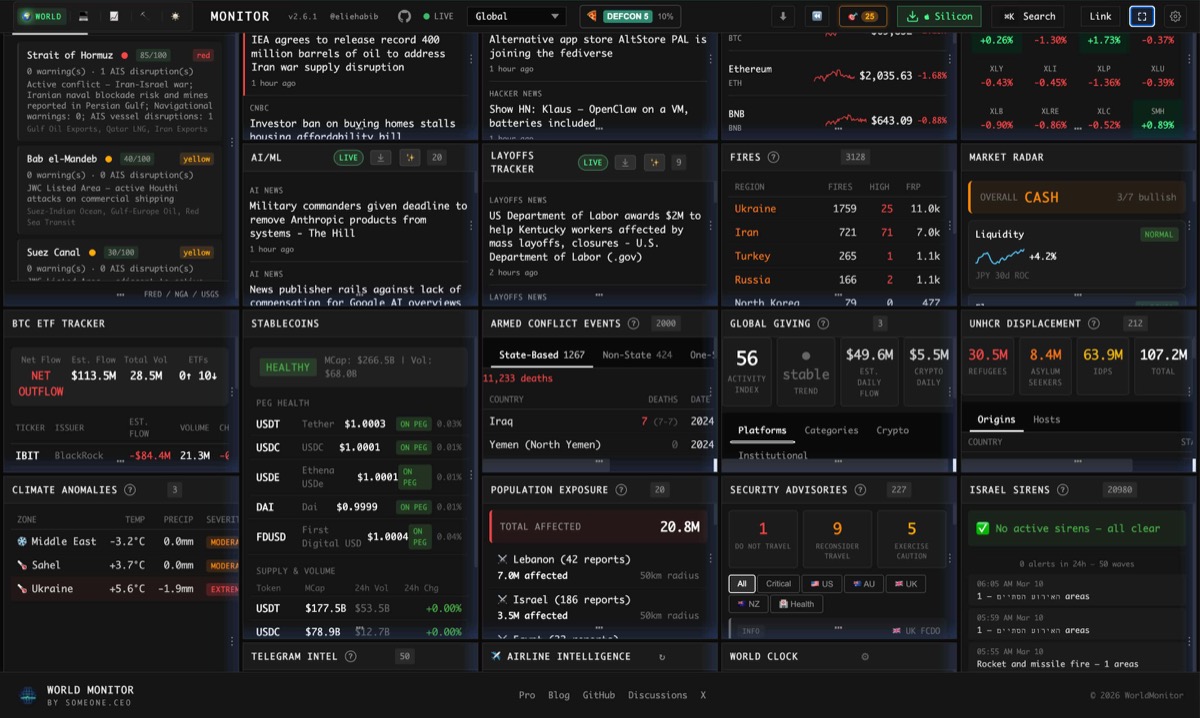
OSINT for Everyone: How Global Watch Democratizes Open Source Intelligence
Open source intelligence used to require a dozen subscriptions, custom scrapers, and years of domain expertise. A professional OSINT analyst’s browser might have 50+ tabs open at any given time: flight trackers, ship trackers, earthquake monitors, conflict databases, Telegram channels, RSS readers, and satellite imagery viewers.
Global Watch collapses that entire workflow into a single interactive dashboard.
The Tab Sprawl Problem
If you’ve ever tried to monitor a developing situation, whether it’s a military escalation, a natural disaster, or a supply chain disruption, you know the drill:
- Open FlightRadar24 for aircraft movements
- Open MarineTraffic for ship positions
- Open USGS for earthquake data
- Open ACLED for conflict events
- Open Liveuamap for real-time mapping
- Open Reuters, AP, and Al Jazeera for news
- Open Telegram for raw OSINT channels
- Open Polymarket for prediction markets
- Open gpsjam.org for GPS interference
- Open NASA FIRMS for fire detection
Each tool has its own interface, its own refresh cycle, its own learning curve. Cross-referencing between them is manual and slow. By the time you’ve built a picture, the situation has moved.
Global Watch integrates all of these data sources (and many more) into a single, layered map with real-time updates.
435+ Intelligence Feeds, Zero Configuration
Global Watch aggregates 435+ RSS feeds organized across 15 categories:
- Geopolitics and defense
- Middle East and North Africa
- Africa and Sub-Saharan
- Think tanks and policy institutes
- Technology and AI
- Finance and markets
- Energy and commodities
- Cybersecurity
Each feed is classified by a 4-tier credibility system, so you always know whether you’re reading a primary source or secondary analysis. Server-side aggregation reduces API calls by 95%, and per-feed circuit breakers ensure one broken source doesn’t take down the dashboard.
Live Tracking: Ships, Planes, and Signals
Three of Global Watch’s most powerful layers bring live tracking to your screen:
ADS-B Aircraft Tracking
Military and civilian aircraft positions update in real time via OpenSky and Wingbits enrichment. The system automatically identifies military aircraft and displays their callsigns, types, and flight paths on the map.
AIS Maritime Monitoring
Ship positions from AISStream.io are merged with USNI Fleet Reports, giving you both transponder data and editorial context from the U.S. Naval Institute. This combination reveals the complete order-of-battle for major naval deployments, something that usually requires a classified briefing.
GPS/GNSS Jamming Detection
ADS-B anomaly data is processed through an H3 hexagonal grid to identify zones where GPS signals are being jammed or spoofed. This is a critical indicator of electronic warfare activity, and Global Watch maps it automatically.
26 Telegram OSINT Channels
Global Watch integrates 26 curated Telegram channels via MTProto, organized by reliability tier:
- Tier 1: Verified primary sources
- Tier 2: Established OSINT accounts (Aurora Intel, BNO News, DeepState, OSINT Defender, LiveUAMap)
- Tier 3: Secondary aggregators (Bellingcat, NEXTA, War Monitor)
These channels often break news 15-30 minutes before traditional media. Having them integrated alongside verified feeds gives you both speed and context.
AI-Powered Threat Classification
Raw intelligence is only useful if you can process it. Global Watch runs a 3-stage threat classification pipeline:
- Keyword matching for immediate categorization
- Browser-based ML (Transformers.js running in Web Workers) for sentiment and entity extraction
- LLM classification for nuanced threat assessment
This runs locally in your browser. No data leaves your machine unless you explicitly choose a cloud LLM provider.
The Country Instability Index
One of Global Watch’s original contributions to OSINT is the Country Instability Index (CII), a real-time 0-100 score computed for every monitored nation:
- Baseline risk (40%): Historical conflict data, governance indicators
- Unrest indicators (20%): Protests, strikes, civil disorder events
- Security events (20%): Military activity, terrorism, border incidents
- Information velocity (20%): News volume spikes that indicate developing situations
The CII is boosted by real-time signals: proximity to active hotspots, OREF rocket alerts, GPS jamming activity, and travel advisory changes. The result is a heatmap overlay that shows, at a glance, where instability is rising.
Hotspot Escalation Scoring
Global Watch doesn’t just show you where things are happening. It tells you where they’re getting worse. The Hotspot Escalation Score combines:
- News activity (35%)
- CII score (25%)
- Geographic convergence (25%): when 3+ event types co-occur within the same 1-degree grid cell in 24 hours
- Military indicators (15%)
When a region’s escalation score spikes, it surfaces in the Strategic Risk panel before traditional media picks up the story.
Sharing Intelligence
Found something significant? Global Watch’s story sharing lets you export intelligence briefs to Twitter/X, LinkedIn, WhatsApp, Telegram, and Reddit, complete with auto-generated Open Graph images for social previews.
You can also share map states via URL: the map position, active layers, time range, and selected data points are all encoded in a shareable link. Send a colleague a URL and they see exactly what you see.
Getting Started with Global Watch for OSINT
- Open globalwatch.vercel.app in any modern browser
- Toggle layers using the left sidebar: start with “Conflicts” and “Military Bases”
- Click any data point on the map for details and source links
- Open the Command Palette (Cmd+K / Ctrl+K) to fuzzy-search across 24 result types and 250+ country commands
- Click any country for its full intelligence dossier with CII score
- Set up keyword monitors for topics you want to track persistently
No account needed. No API keys required for the web version. For local AI analysis, install Ollama and point Global Watch at your local instance.
Why Open Source Matters for OSINT
Closed-source intelligence tools are black boxes. You can’t verify how they score threats, where their data comes from, or whether their algorithms have blind spots.
Global Watch’s AGPL-3.0 license means every scoring algorithm, every data pipeline, and every AI prompt is open for inspection. Security researchers can audit it. Academics can cite it. Developers can extend it. And anyone can self-host it for complete operational security.
Start your OSINT workflow at globalwatch.vercel.app. Free, open source, and no login required.